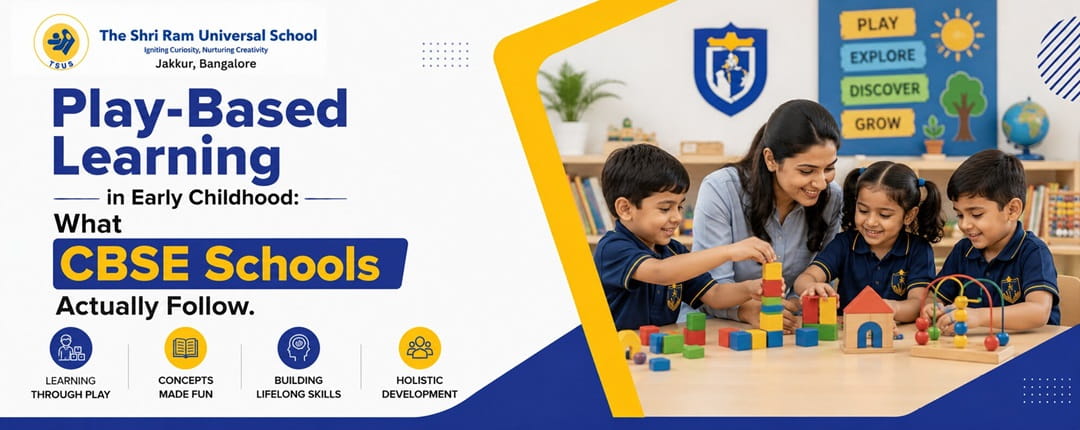
Walk into a genuinely good pre-primary classroom, and it does not look like what most parents expect. There is noise. Children are on the floor. Someone is building something with blocks, someone else is arguing about whose turn it is, and a third child is running a pretend shop with bottle caps and leaves. The teacher is somewhere in the middle of all of it, watching carefully and occasionally asking a question.
This is not chaos. This is learning. It just does not look like the version most of us experienced.
What Is Play-Based Learning? (And What It Isn’t)
Play-based learning is an approach to early childhood education where play is the primary vehicle through which children develop cognitive, social, emotional, and physical skills. The operative word is primary. Not supplementary. Not a break from learning. Play is the learning.
What it is not is equally important to understand. Play-based learning is not free time with no adult involvement. It is not an absence of structure or intentional curriculum. And it is absolutely not sending children outside to run around while teachers wait for the “real” lesson to begin.
Quality play-based learning involves carefully designed environments, intentionally chosen materials, and skilled teachers who observe, facilitate, and extend children’s thinking through the play itself. The difference between genuinely good pre-primary practice and supervised recreation is significant, and parents visiting schools should know how to tell them apart.
Why Play Is the Primary Mode of Learning Before Age 8?
Cognitive Development Through Play
Before age eight, children’s brains are developing in ways that make abstract, seated, instruction-based learning genuinely inefficient. This is not a preference or a philosophy. It is neuroscience.
When a four-year-old stacks blocks and they fall, they are encountering physics. When they sort coloured buttons into groups, they are doing early mathematics. When they negotiate with a classmate over who gets the red crayon, they are practising executive function, specifically impulse control and perspective-taking, which are skills that correlate more strongly with long-term academic success than early reading or numeracy scores.
The brain at this age learns through doing, through repetition that is self-motivated, and through problems that the child themselves finds interesting enough to persist with. Play provides all three of these conditions naturally.
Social-Emotional Learning Through Play
This is the developmental area that school assessments almost never measure and that turns out to matter most.
Children who play in groups, particularly unstructured or loosely structured group play, are constantly practising regulation. They feel frustrated and choose whether to hit or negotiate. They feel excluded and figure out what to do with that. They want something another child has and have to navigate that desire in a social context.
These experiences, accumulated across hundreds of play sessions over the pre-primary years, are what produce children who can manage their emotions, cooperate, and persist through difficulty. Academic skills can be taught later. The window for this foundational social-emotional development is narrower than most parents realise.
How CBSE’s NEP 2020 Foundational Stage Mandates Play-Based Learning?
The National Education Policy 2020 is the most explicit that Indian educational policy has ever been about play-based learning, and it is not subtle about it.
NEP 2020 establishes a Foundational Stage covering ages three to eight, which includes Nursery, LKG, UKG, and Classes 1 and 2. For this entire stage, the policy mandates a play-based, activity-based, and discovery-based approach to learning. The language in the policy is direct: rote-based learning and premature academic pressure are explicitly identified as harmful practices to be eliminated.
CBSE schools are expected to implement this through the NIPUN Bharat framework, which sets learning outcomes for the foundational stage that are assessed through observation and activity rather than formal examination. The shift is significant. A school genuinely implementing NEP 2020 at the pre-primary level should not have children sitting at desks copying letters for extended periods in Nursery or LKG. If they are, the school is not following the policy it claims to follow.
Types of Play Used in Quality CBSE Pre-Primary Classrooms
Structured vs. Unstructured Play
Structured play has a defined purpose and materials chosen by the teacher. A counting activity using natural objects, a sorting game, a guided art project where children explore colour mixing. The teacher introduces it, but the child leads within the structure.
Unstructured play is child-initiated and child-directed. The teacher sets up the environment and steps back. Children decide what to do, who to play with, and how long to stay with an activity. Both types are necessary. A classroom with only structured play is too controlled. A classroom with only unstructured play is missing the intentional scaffolding that helps children consolidate learning.
Outdoor Play and Gross Motor Activities
Outdoor time in a quality CBSE pre-primary programme is curriculum, not a break from it. Running, climbing, digging, carrying, and balancing all develop gross motor skills that are directly connected to fine motor development, which in turn connects to writing readiness.
Beyond the physical, outdoor play is where children encounter nature, manage physical risk, and learn spatial awareness. Schools that restrict outdoor time or treat it as optional are missing a significant component of foundational development.
Imaginative and Dramatic Play
A child who spends twenty minutes being a doctor, diagnosing stuffed animals and writing prescriptions in invented script, is doing something cognitively remarkable. They are holding a fictional scenario in mind, assigning roles, using language for pretend purposes, and often incorporating early literacy and numeracy naturally.
Dramatic and imaginative play, specifically, is one of the strongest predictors of narrative language development, which is one of the strongest predictors of reading comprehension several years later. A home corner, a puppet theatre, or dress-up materials in a pre-primary classroom are not decorations. They are serious pedagogical tools.
How to Tell if a School Genuinely Follows Play-Based Learning (Not Just Claims It)?
Almost every school in India now uses the phrase “play-based learning” in its admissions material. Very few schools actually practise it in any meaningful way. Here is how to tell the difference when you visit.
Look at how much time children spend seated at desks versus on the floor, at tables with materials, or moving around. In a genuine play-based classroom, seat time should be minimal for Nursery and LKG.
Ask to see the weekly timetable. If it shows discrete forty-minute subject periods with named subjects like English, Maths, and EVS in Nursery, the school is using a primary school structure for pre-primary children, which is not play-based learning regardless of how it is described.
Ask what the teachers observe and document. Quality play-based practitioners keep observational records of individual children’s development. If the school cannot show you examples of teacher observation notes or developmental portfolios, the approach is likely more traditional than the marketing suggests.
Notice whether children look engaged or compliant. Engaged children argue, negotiate, get absorbed, and sometimes get frustrated. Compliant children sit quietly and follow instructions. One of these environments is producing learning. The other is producing behaviour management.
Play-Based Learning at Home: Activities Parents Can Do
School is only part of it. Children in the foundational years learn continuously, and home environments matter considerably.
Give children time that is genuinely unscheduled. Not screen time, and not structured activity classes. Time where they are mildly bored and have to figure out what to do. This is where creativity comes from.
Play alongside your child rather than directing their play. Sit on the floor with the blocks and build your own thing. Ask genuine questions about what they are making. Follow their lead rather than demonstrating the “right” way to do something.
Read aloud daily, and do not stop reading aloud when children start reading independently. The vocabulary and comprehension exposure from being read to exceeds what early readers can access themselves, sometimes for years.
Cook together, plant seeds, take things apart, make things with their hands. These multi-sensory experiences build the concrete understanding that all later abstract learning depends on.
See How TSUS Bengaluru’s Early Years Programme Is Designed
Understanding the principles of quality early childhood education is important. Experiencing how those principles are translated into everyday learning is what truly helps parents make informed decisions.
The Shri Ram Universal School (TSUS) Bengaluru is committed to creating a nurturing, child-centred environment where young learners develop curiosity, confidence, and a lifelong love for learning. Guided by the values of the Shri Ram Educare philosophy, the school’s Early Years Programme focuses on experiential learning, play-based pedagogy, and meaningful exploration.
Through thoughtfully designed learning spaces, engaging activities, and a balanced curriculum, children are encouraged to learn at their own pace while developing essential cognitive, social, emotional, and communication skills.
If you are exploring schools in Bengaluru for your child’s foundational years, we invite you to visit TSUS Bengaluru, interact with our educators, and experience our learning environment firsthand.
To learn more about admissions and the Early Years Programme, visit The Shri Ram Universal School Bengaluru.